


Why Poker Players Approach Online Pokies Differently From Casual Casino Players

Poker players who occasionally play pokies on the side approach the games with a very different mental model from a casual casino player. The gap is not about knowledge of the games themselves, since pokies are simple to play regardless of your background. The gap is about how you think about variance, bankroll, and edge.
The mental adjustment is worth understanding even for casual pokie players. Research from the Australian Gambling Research Centre finds that 70 percent of Australian gamblers play multiple products, so poker players crossing into pokies is a common pattern rather than an unusual one. Poker instincts tend to produce characteristic mistakes on pokies that lose money faster than a naive casual player would.
This piece walks through the mindset shifts a poker player needs to make when loading up pokies online alongside their usual poker grind. Each shift matters for actual results.
Skill Edge Versus House Edge
The most fundamental difference between poker and pokies sits at the level of edge. A winning poker player has a skill edge over the field, which over a large enough sample translates into positive expected value per hand. If you play a hand better than your opponents, you win more than you lose over time.
Pokies work the opposite way. The house has a mathematical edge built into the RTP percentage of every game, ranging from around 94 percent on tighter machines to 97 percent on the best online pokies. No skill decision changes this, since every spin is independent and the house edge applies regardless of how the player approaches the game.
For a poker player, this is the first mental adjustment. Nothing you do at the pokie changes the expected value, since there is no bet-sizing tell to read, no opponent to exploit, and no fold equity to capture. The edge is fixed against you, and the only choices you actually control are how much to bet per spin, how many spins you take, and when to stop.
Variance Feels the Same But Behaves Differently
Poker players already understand variance intuitively. Bad beats, downswings, and running below expected value for stretches are all part of the game, and experienced players learn not to react emotionally to short-term results. That variance-tolerance instinct is one of the most valuable habits a poker player brings to pokies.
But pokie variance behaves differently from poker variance in one important way. Poker variance oscillates around a positive expectation for a skilled player, while pokie variance oscillates around a negative expectation for everyone. A downswing in poker means you are running below your true edge; a downswing on pokies is just the house edge doing what it does, with no long-run recovery through play.
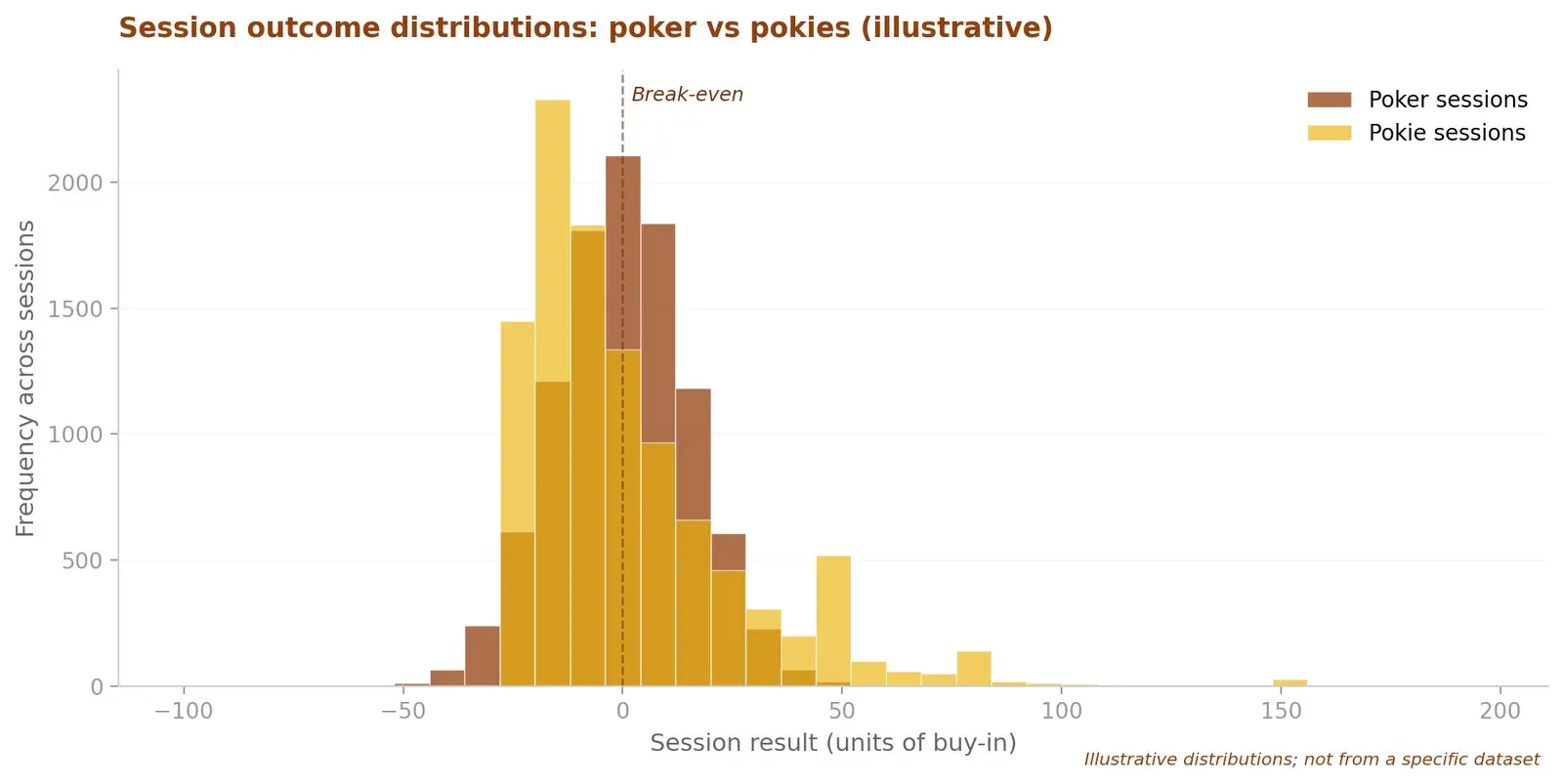
The visual difference between the two distributions is worth looking at directly. Poker sessions cluster tighter around a small positive expectation for a winning player; pokie sessions spread wider around a modest negative expectation with occasional large-win outliers that skew the distribution.
The Six Mindset Shifts That Actually Matter
Poker players moving to pokies need to make six mental adjustments to avoid the characteristic mistakes their poker instincts otherwise produce:
- Stop reading patterns that are not there. Poker players are trained to read patterns in opponent behaviour and adjust. Pokies have no patterns to read. Each spin is independent, the RNG has no memory, and hot-streak or cold-streak intuitions are cognitive errors rather than signal.
- Adjust bankroll unit size downward. A poker player might comfortably risk one percent of bankroll per buy-in because their skill edge recovers losses over time. A pokie player has no such recovery mechanism, so unit sizing per spin should be smaller relative to bankroll than a poker player’s instinct would suggest.
- Set explicit session-end conditions. Poker sessions naturally end when the game breaks, opponents leave, or fatigue affects decision quality. Pokies never end on their own. Setting a pre-committed stop-loss and stop-win before the session starts is essential, because otherwise session length will keep extending toward the negative expectation the RTP guarantees.
- Treat bonuses as EV adjustments, not free money. Poker players evaluate rakeback deals and bonuses as EV per hand. The same discipline applies to pokie bonuses: work out the wagering requirement, the game contribution rates, the max-bet restriction, and the actual effective bonus value after conditions rather than the headline number.
- Do not chase losses. This applies in both games but the mechanism differs. Chasing at poker sometimes works because a skilled player can genuinely turn a session around against weaker opponents. Chasing at pokies never works because the underlying negative expectation continues regardless of how many additional spins you take.
- Accept the entertainment framing. Poker is a profession or side income for many rakeback readers. Pokies cannot be that for anyone. If a poker player continues to treat pokies through the same lens (income potential, EV maximisation, skill development), they will lose money faster than a casual player who correctly frames pokies as paid entertainment.
Each shift is small on its own. The combined effect of all six is the difference between a poker player who plays pokies rationally on the side and one who treats pokies as another edge-generating game and loses money accordingly.
Session Structure and Time Discipline
Session structure is where the biggest practical adjustment happens. A poker cash game session might run four to six hours because a skilled player is generating positive EV throughout. A pokie session lasting four to six hours will burn through bankroll at whatever rate the RTP dictates, with no offsetting skill edge to slow the descent.
Experienced poker players who play pokies well run much shorter sessions, typically thirty to sixty minutes rather than multi-hour marathons. The rationale is straightforward: since every spin has the same negative expected value, more spins means more negative expectation realised. Time-boxing the session is the most effective single intervention.
The related discipline is not stacking pokie sessions after losing ones. A poker player after a losing session might sit down for another because they trust their long-run edge, but a pokie player after a losing session who sits down for another is just adding more spins at the same negative expected value. No recovery mechanism justifies the extra volume.
What This Means for Poker Players in Practice
The practical takeaway is that pokies are a legitimate leisure activity for poker players, but only if the mental model adjusts fully rather than partially. The half-adjusted approach is worse than either full adjustment or no play at all, whether that means understanding variance but not adjusting bankroll units, or setting stop-losses but chasing them when hit.
Rakeback and bonus structures on pokies also work differently from poker rakeback. Poker rakeback returns a portion of the rake the player has paid, which offsets a real cost of playing. Pokie cashback and reload bonuses are also EV positive but only within their wagering-requirement structures, and evaluating them properly requires the same analytical discipline poker players apply to their poker rakeback deals.
The underlying question every poker player should ask before loading a pokie session is whether they are treating it as entertainment or as an edge game. The honest answer will save more money than any strategy tip about which pokies to pick or when to spin. Entertainment framing works; edge framing does not.
Recent Posts:
Top Poker Room Recommendation

- 27% Rakeback
- $2000 Sign-up Bonus
- Bonus Code: RBCOM
Let's keep in touch